Research Team
Meet the researchers behind Infrastructures of Courtesanship.
Principal Investigator
Dr Radha Kapuria
Dr Radha Kapuria is a historian at Durham University, where she teaches South Asian and global history and supervises doctoral research in the Department of History. Her work repositions performance as foundational to social and political history, reconceives gendered mobility as structurally embedded rather than incidental, and foregrounds the urban, social and ecological infrastructures that have sustained cultural labour across South Asia’s past. Her monograph, Music in Colonial Punjab (2023) rewrites the historiography of colonial modernity by placing gendered cultural labour at the centre of sovereignty, politics and public culture. Reconstructing the worlds of courtesans and hereditary male musicians across late-Mughal, Sikh and British regimes, drawing on multilingual archives in Punjabi, Urdu, Hindi and English alongside visual sources, the book establishes performers as active agents in reconfiguring power rather than passive subjects of decline. It received a Special Mention at the Karwaan Book Award (2024). She is part of an ongoing transnational study, along with Dr Nicole Ranganath (UC Davis), and Navkiran Natt (Delhi) on gender, violence and memory around the 1947 Partition, examining new musical practices among Punjabi women in India, Pakistan and the diaspora.
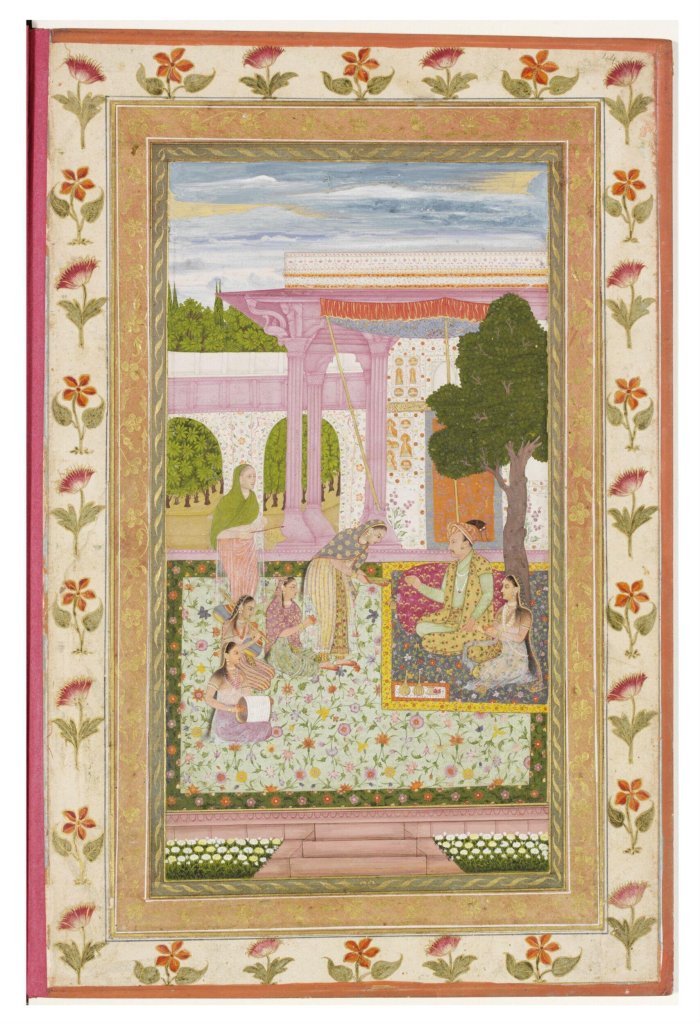
Across her research, music and sound emerge as key infrastructures of affect and authority. She currently leads the Infrastructures of Courtesanship project, which asks how gendered performance operated as a form of infrastructure through which power, mobility and social worlds were organised across South Asia. Where courtesans have conventionally been studied as representatives of an ephemeral performance tradition, this project turns instead to their built environments–salons, temples, mosques, imambaras, sarais, water tanks, pleasure gardens– as sites through which female performers’ authority and mobility were materially sustained. Covering North India from c. 1700 to 1950, and drawing on multilingual archival research, GIS mapping of architectural sites, visual analysis of Pahari paintings and print, and ethnographic fieldwork, the project challenges narratives that frame courtesanship through moral decline or colonial suppression, showing instead how performance analysed through material, legal and spatial systems reveals forms of power often obscured in state-centred or musicological accounts. This project builds on her related work in the 2026 Special Issue of the Journal of the Royal Asiatic Society, on ‘The Travelling Female Performer: Mobility and Agency in and beyond South Asia, c. 1760–1940’, which develops the concept of gendered mobility as strategic negotiation, tracing how women performers navigated constraints of law, honour and patronage across early modern and colonial contexts.
Architectural History
Dr Parshati Dutta
Dr Parshati Dutta is an architect and a cultural heritage conservation consultant who recently completed her PhD on architectural matronage in Mughal India at the University of York, funded by the University and the British Institute of Persian Studies. Her work has been published in journals like South Asia, Religions of South Asia, and the International Journal of Islamic Architecture, and several edited collections.
Art History
Dr Vrinda Agrawal
Vrinda Agrawal is a PhD candidate in the History of Art at the University of Michigan, Ann Arbor. Her research focuses on early modern South Asian art, particularly Pahari painting, with interests in patronage, collecting, and visual culture. She holds an MA from SOAS, University of London, and a BFA from the School of the Art Institute of Chicago. Her work has appeared in journals such as Ars Orientalis and Artibus Asiae, as well as in museum and exhibition catalogues.
Digital Humanities
Dr Giacomo Alliata
Dr Giacomo Alliata is Postdoctoral researcher in Performing Arts Analytics at UFR Arts, Lettres, Communication, Université de Rennes 2 in France as part of the European Research Commission-project STAGE: From Stage to Data. He completed his PhD in 2025 at the Laboratory for Experimental Museology,
EPFL in Switzerland.
Priyanka Das
Priyanka Das is currently a final semester student in the M.Sc. in Digital Humanities at the Indian Institute of Technology in Jodhpur, with a specialisation in museums, galleries, and archives. Her Masters’ thesis engages with the visual and material world of Rajput courtly culture. She has worked with the Museum of Art and Photography (MAP), Emami Art, and Delhi Art Gallery (DAG), where she contributed to archival documentation, metadata management, and provenance research across large institutional datasets.
Literary History (Knowledge Infrastructures)
Asad Fatemi
Asad Fatemi is an independent author, poet, scholar, and calligrapher based in Lahore. His work moves across Urdu, Punjabi, and Persian literary traditions, engaging deeply with poetic articulation and classical aesthetics. His debut poetry collection, Pas-Andaz, embodies an interplay of forms, stylistic registers, and poetic lexicon, while its themes traverse human subjectivity and the enduring tensions between tradition and modernity. His research has most recently been published in the Journal of the Royal Asiatic Society. Fatemi’s work reflects a deep engagement with language, form, and literary heritage, and contributes to contemporary conversations around poetry, identity, and cultural continuity in South Asia.

